Since the overturning of Roe v. Wade in 2022, America needs bold leadership to continue to advance the cause of life. That’s why we’re uniting as pro-life leaders across the country around a path forward that is laser-focused on care for young children and their parents.
This is the next phase of the pro-life movement.
This is our Blueprint for Life.
What is Blueprint for Life?
Our Policy Pillars

Mentorship and Community
Research consistently shows that strong relational networks and dedicated mentoring are among the most effective means of advancing upward mobility and helping families navigate the complexities of post-pregnancy life. Children and new parents need these relationships, not just financial support, to ensure long-term flourishing. The coalition supports mentoring initiatives in partnership with local and faith-based organizations and a greater focus on mentoring partnerships in schools and social services programs.

Increasing Information Availability
Many pregnant and new mothers are unaware of the array of federal, state, and local resources available to them to support them in their pregnancy and parenting journey. The coalition supports greater clarity and availability of resource information by creating a national "one-stop" online resource website and increasing information available on college campuses and workplaces.

Supporting Healthy Moms and Babies
Healthcare challenges are at the forefront of pregnant moms' and new parents' minds. The coalition supports strengthening healthcare resources and services for children and parents, mainly by examining services available under SCHIP and the WIC program, expanding Medicaid to cover post-partum care, and greater support of community health and pregnancy resource centers.

Providing Flexible Resources to Parents
Parents consistently report the financial burden of childbearing and childrearing, more than half of abortions take place among low-income families, and women choosing abortions consistently cite financial limitations as a reason for choosing to abort the child. A greater culture of life would minimize the financial burden on parents to underscore the moral and societal value of preserving such life. To do so, the coalition promotes two core policies: extension and expansion of the child tax credit (including greater levels of refundability) and institution of a federal paid family leave policy to get more resources in the hands of parents in the fourth trimester.

Making Childcare More Affordable
Many pregnant moms and new parents face the dual stressors of being present for a new child and ensuring they have the resources to support their families. Safe and affordable childcare is essential to making this possible, particularly for low- and middle-income families who cannot meet their needs under a single earner. The coalition supports increasing resources for childcare, ensuring that faith-based providers have access to such resources, and leveling the playing field for families that would prefer a stay-at-home parent or relative care.

Broadening Partnerships with Faith Based Organizations and Non-Profits
Churches, nonprofits, and other private organizations are essential players in a culture of life and already account for billions of dollars of care-related resources. These organizations provide crucial resources and offer relational networks needed to support new parents and children and set them up for lifelong growth and care. The coalition supports greater information-sharing between government and faith-based/nonprofit organizations, resources to support nonprofit and faith-based social services initiatives, and more robust legal protections for faith-based organizations partnering with government actors.

Expanding Resources for Adoptive and Foster Parents
Supporting adoption is one of the most important ways to create communities of care and a culture of life. The availability of adoptive services can be a significant motivator for mothers to carry a child to term. The coalition supports reducing the financial burdens of adoption by expanding the adoption tax credit and taking steps to simplify and streamline the adoption process, strengthen the foster care system through nonprofit partnerships, and harmonize resources available to biological and adoptive parents with young children.
Pro-Life Pro-Baby Maternal Health Kit
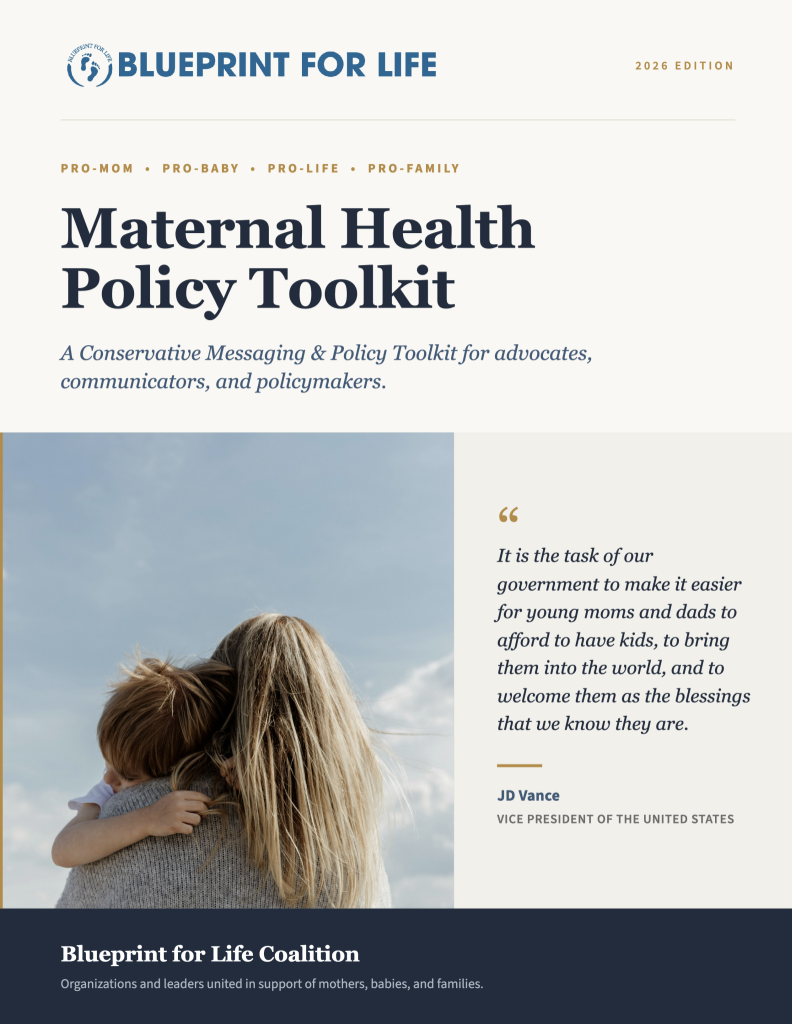
“It is the task of our government to make it easier for young moms and dads to afford to have kids, to bring them into the world, and to welcome them as the blessings that we know they are.”
— JD Vance
Vice President of the United States
Members of Blueprint for Life Coalition
Rick Santorum, Former U.S. Senator, Pennsylvania, Chairman, Patriot Voices
Douglass Leadership Institute
Americans United for Life
American Principles Project
National Hispanic Pastors Alliance
Live Action
American Association of Pro-Life OBGYNs
Pro-Life Action League
Project Pathfinders
Mike Huckabee, Former Governor of Arkansas
Christian Employers Alliance
Family Policy Alliance
Pro-Life Partners Foundation
Human Coalition Action
Heartbeat International
Democrats for Life
ProLove Ministries
And Then There Were None
Patrick Brown, Ethics and Public Policy Center
Students for Life Action
Catherine Glenn Foster, First Rights Global
Kathryn Jean Lopez, National Review Institute
Care Net
The National Association of Evangelicals (NAE)
The Vitae Foundation
Samuel Rodriguez, National Hispanic Christian Leadership Conference
Moms for America
and more…
Relevant News